
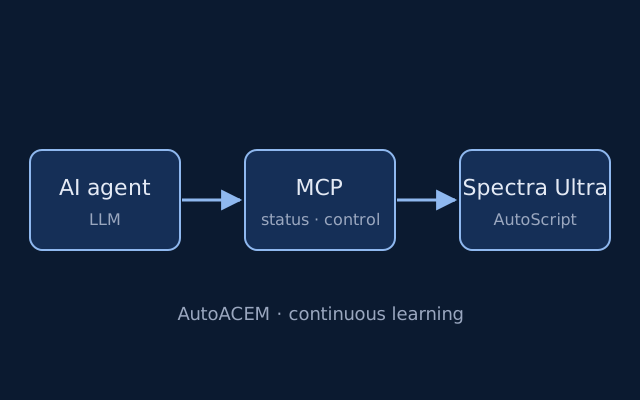
We welcome collaborations that use atomic-resolution tools such as the Spectra Ultra to tackle grand challenges in science. Our toolkit includes:
- the Thermo Fisher AutoScript API;
- a custom MCP server that provides a user-interface simulator together with instrument status and control;
- commercial large language models;
- AutoACEM, our automated control interface.
At the heart of this project is continuous, reinforcement-driven learning, which steadily expands what the ecosystem can do. Collaborate with us.
Latest result: from zero to atoms
In one real session on November 5, 2026, an AI agent took the Spectra Ultra from wherever the last user had left it (120 kV, TEM mode, a random stage position) to atomic-resolution HAADF-STEM of SrTiO3 [001] at 300 kV in 1 hour 43 minutes. It tuned the corrector, fixed its own problems and wrote 20 new tools, including a route to the zone axis that took 27 minutes instead of 70 by hand, all within hard safety limits and with a STOP button at hand. Read the story and watch the video.
Strategy
- Data. Automatic data collection helps overcome the shortage of training data, and the data it produces trains better agents.
- Institutional data. An institution’s business data is a key asset: it should be safeguarded and fed to the institution’s own agents to build a smart institution.
- Top-tier design, local day-to-day work. Top-tier models design the system; institutional AI models run local tools for the day-to-day work, which does not need the smartest model.
Milestones
- November 5, 2026: Zero to atoms: an AI agent takes the Spectra Ultra from a random state to atomic resolution
- November 3, 2026: ACEM Core joins ABRF webinar on using AI tools to manage instrument booking system
- October 22, 2026: Two AI agents iterate on an experiment in a closed loop
- October 1, 2026: AI agents now available on the core’s instruments
AutoACEM system architecture and design: Sebastian Y. Deng, Dr. Shize Yang and Dr. Chaoya Han. Videos are on the ACEM Core YouTube channel.